
Brothers Bond Essays
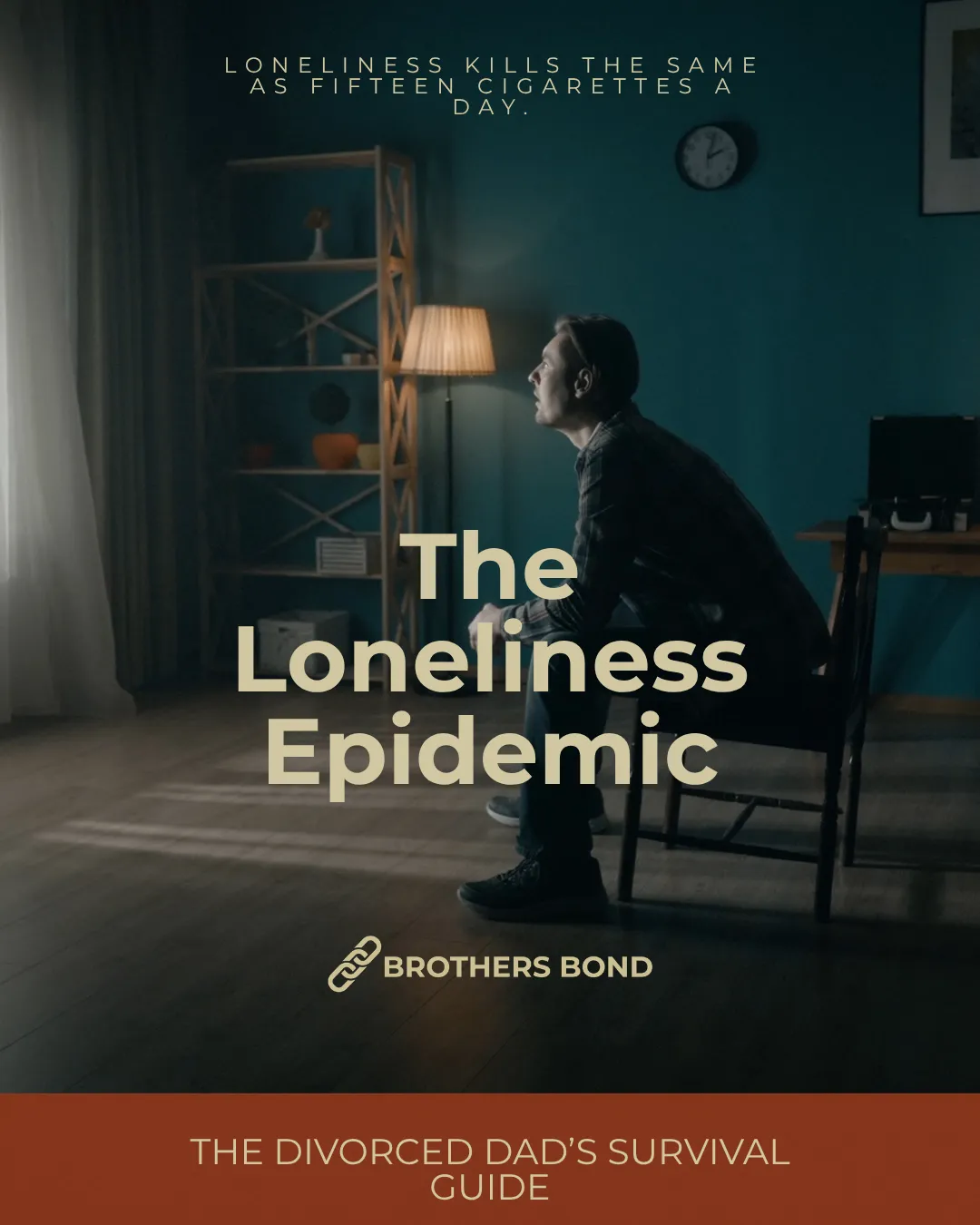
An Epidemic That is a Killer.
Divorced men are nearly twice as likely to die prematurely compared to their married counterparts. They have significantly higher rates of depression, substance abuse, and suicide than both married men and divorced women. These are not just statistics. They are warning signs of a public health crisis hiding in plain sight, one that kills quietly through isolation rather than infection.
The numbers tell a stark story, but they do not capture the lived reality. The divorced man who realizes he has been alone in his house for three consecutive weekends. The one who cannot remember his last meaningful conversation. The one whose only regular human contact happens at work or the drive-through window.
Sound familiar? It sure does to me. I know that toll. I have lived it.
“Loneliness for divorced men isn’t just about being alone in a room. It’s about feeling like you no longer have a place in anyone’s story—including your own.”
— From The First 90
The Physical Toll of Chronic Loneliness
Loneliness is not just an emotional state. It is a physiological stressor with measurable health consequences. Dr. Julianne Holt-Lunstad, a professor of psychology and neuroscience at Brigham Young University, has conducted extensive research showing that chronic loneliness increases mortality risk by roughly the same magnitude as smoking fifteen cigarettes a day.
The cardiovascular system takes a particularly severe hit. Lonely individuals show elevated blood pressure, increased inflammation markers, and higher cortisol levels. That is the stress hormone that, when chronically elevated, damages nearly every system in the body. Studies have found that socially isolated men face a 29 percent increased risk of heart disease and a 32 percent increased risk of stroke.
The immune system suffers too. Chronic loneliness triggers inflammatory responses while simultaneously weakening the body's ability to fight off infections. Research published in the journal Comprehensive Psychoneuroendocrinology found that lonely individuals show altered immune cell gene expression, making them more vulnerable to viral infections and slower to heal from wounds.
Sleep disruption compounds these problems. Lonely people sleep more fitfully, wake more frequently, and report lower sleep quality even when they get adequate hours. Poor sleep further degrades immune function, cognitive performance, and emotional regulation, creating a vicious cycle where loneliness breeds exhaustion and exhaustion deepens isolation.
Brotherhood Resources
The complete series "A Divorced Dad's Survival Guide"
Daily Bond Boosts
Daily Motivation in seconds
Delivered by email or Text
Crafted in monthly sections
A new theme each month
Holiday Stress Relief
Join the Forge
A private confidential group of men navigating seperation, divorce and rebuilding life. Monthly and annual subscriptions available.
More Resources
Library: List of the top 50 books that helped us on our journies
Essays: An ongoing series of essays hitting on the topics that matter most from the man's perspective.
Masterclass: Coming Soon
The Mental Health Crisis Men Don't Report
Depression rates among divorced men significantly exceed those of married men and divorced women, yet men are far less likely to seek treatment or even recognize their symptoms. This is not because men do not experience depression. It is because male depression often manifests differently than the clinical textbook describes.
Research consistently shows that men frequently express depression through irritability, anger, and risk-taking rather than sadness and withdrawal. They are more likely to report physical symptoms, chronic pain, digestive issues, headaches, than emotional distress. When a man says he is "stressed" or "tired all the time," he may actually be describing unrecognized depression.
I told everyone I was fine. I said it so many times I almost believed it myself. But fine men do not snap at baristas over minor mistakes. Fine men do not lie awake at 3 AM with their minds racing. Fine men do not feel a crushing weight on their chest for no apparent reason.
The stigma around mental health hits men with particular force. Admitting emotional struggle feels like admitting weakness, failure, or inadequacy. Many men were raised with explicit or implicit messages that real men do not need help, do not complain, and certainly do not cry. Divorce already feels like a public failure. Acknowledging psychological distress on top of that can feel unbearable.
Anxiety, too, goes unrecognized and unreported. Men may not identify the constant tension, the racing thoughts at 3 AM, the hypervigilance, or the difficulty concentrating as anxiety. They push through, tell themselves they are fine, and wonder why nothing feels right anymore.
The Self-Medication Trap
Faced with emotional pain they have not been taught to articulate or address, many men reach for the numbing agents readily available: alcohol, overwork, pornography, compulsive exercise, or new relationships entered too quickly for the wrong reasons.
Alcohol offers immediate relief from emotional distress, and divorced men show significantly higher rates of problem drinking than their married peers. What starts as a couple of beers to take the edge off evolves into a nightly ritual, then a dependence. The Centers for Disease Control and Prevention reports that men account for three out of four alcohol poisoning deaths, and divorced men are overrepresented in those statistics.
Work becomes another escape. Throwing yourself into your career provides structure, distraction, and a sense of competence when everything else feels chaotic. It is socially acceptable, even praised. Nobody questions the guy staying late at the office, but he may be avoiding an empty home and the thoughts that surface in silence.
I became that guy. The one who volunteered for every extra project, who stayed at the office until the cleaning crew arrived, who checked email compulsively on weekends. My colleagues probably thought I was ambitious. The truth was simpler and sadder. I had nowhere else to be and nothing else to do.
These coping mechanisms create their own problems. Alcohol disrupts sleep, impairs judgment, and increases depression. Overwork leads to burnout and physical health problems. Using relationships as emotional band-aids hurts both parties and prevents genuine healing. They are all just temporary relief which over time become another source of harm.
Why Men Are Particularly Vulnerable
Male socialization creates specific vulnerabilities that intensify post-divorce loneliness. While women typically maintain networks of emotionally intimate friendships throughout their lives, men often have activity-based friendships that lack emotional depth. You can play basketball with someone every week for years without ever discussing what is actually going on in your life.
Dr. Niobe Way, a developmental psychologist at New York University who has studied male friendships extensively, found that boys have deep, emotionally intimate friendships in early adolescence but abandon them by late high school as they learn that emotional openness between men is suspect. By adulthood, many men have no practice articulating emotional needs or vulnerabilities.
The result is that when crisis strikes, and divorce certainly qualifies, men do not have the social-emotional infrastructure to support them through it. They may not even have the vocabulary. Asking "how are you really doing?" receives an automatic "fine" because genuinely answering that question requires skills that have atrophied or were never developed.
The stigma around asking for help compounds the problem. Therapy feels like an admission of defeat. Reaching out to friends risks seeming needy or burdensome. Many men would rather suffer in silence than risk the perceived humiliation of acknowledging they are struggling.
Alone Versus Lonely
It is crucial to distinguish between being alone and being lonely. Solitude can be restorative, chosen, and meaningful. Loneliness is the painful gap between the connection you have and the connection you need. You can be lonely in a crowded room and content alone in nature.
Some divorced men discover they actually enjoy solitude after years of marital conflict or obligation. They appreciate the freedom, the quiet, the ability to make decisions unilaterally. That is not loneliness. That is autonomy, and it can be healthy.
Loneliness is different. It is the persistent feeling that no one really knows you, that you do not matter to anyone, that you could disappear and no one would notice for days. It is scrolling through your contacts and finding no one you feel comfortable calling. It is the ache for connection that goes chronically unfulfilled.
I spent weeks trying to convince myself I was just enjoying my independence, that I had always been somewhat introverted anyway. But there is a difference between choosing solitude and having it chosen for you. There is a difference between peaceful alone time and the echo chamber of your own worst thoughts with no one to talk you down from the ledge.
Treating Loneliness as a Health Emergency
The evidence is overwhelming. Chronic loneliness kills. It increases cardiovascular disease, weakens immune function, accelerates cognitive decline, and dramatically elevates risks of depression, anxiety, and suicide. For divorced men already facing elevated mortality risk, unaddressed loneliness becomes a genuine survival issue.
This is not about being dramatic or self-indulgent. Treating loneliness seriously is self-preservation. You would not ignore chest pain or a suspicious lump. Persistent, painful isolation deserves the same urgent attention.
The good news is that loneliness is addressable. Therapy helps. Building or rebuilding friendships helps. Joining groups, volunteering, or finding structured social activities helps. Even small interventions, regular phone calls with a friend, a weekly hobby group, a men's support group, can make measurable differences in both emotional wellbeing and physical health outcomes.
I did not realize how isolated I had become until my doctor asked a simple question during my annual physical: "How many people would you say you have meaningful conversations with in a typical month?" I sat there counting and felt my throat tighten when I reached zero.
"That's a health risk," he said flatly. "Like high blood pressure or smoking. We need to address it."
It was the first time anyone had named what I was experiencing as something medical, something serious, something that deserved treatment rather than shame. That conversation saved my life. It also led to the creation of Brothers Bond.
Books that helped us think this through
If the numbers in this piece landed, here is the reading. Loneliness by John Cacioppo is the foundational science. Together by Vivek Murthy is the public-health case from a former Surgeon General. Why Zebras Don't Get Ulcers by Robert Sapolsky shows you what chronic cortisol is doing to your body right now, and Why We Sleep by Matthew Walker shows you the sleep cost compounding on top. For the mental health side, Men and Depression by Fredric Rabinowitz and Sam Cochran, and I Don't Want to Talk About It by Terrence Real, explain why this hits us the way it does, and why most of us miss it on ourselves. Outlive by Peter Attia is the longevity argument for taking this seriously now.
If the numbers in this piece landed harder than you expected, you are exactly the man Brothers Bond was built for. Join Bond Boosts at brothersbond.com. Small daily messages. Brothers who have been there.
In Brotherhood
Some links above are Amazon affiliate links. Brothers Bond may earn a small commission at no cost to you.
_________________________________________________